Behind the sound · · Tomek Piskor-Ślesicki
The filter behind Stockhausen's Kontakte
W49 Hörspielverzerrer. I know, it's a catchy name. If I ever start a heavy metal techno band, that's what I'm calling it. Don't blame me.
That's what's written on the plate: a radio-play distorter, built by Maihak in Hamburg in the 1950s so a broadcast studio could bend a voice into something that wasn't a voice, for a drama nobody would ever see.
The W49 went on to shape some of the most important electronic music of the last century, and the unit in my studio spent its working life in the Polish Radio Experimental Studio. Rysy is sampled from that filter, and from the tube preamp it was built to feed.
the unit
- maker
- Maihak
- built
- 1950s
- where
- Germany
- what it is
- Passive stepped filter, built for radio plays

The Maihak W49 from the Polish Radio Experimental Studio now lives at the Felt Instruments studio.
Built for radio plays
Maihak built for state broadcasters, and in the 1950s that meant no reason to cut a corner anywhere. Everybody's money is nobody's money (or so they say), so what mattered was the sound, not the economics.
Unlike most equipment of the early electronic music era, the W49 isn't repurposed test gear. It was built on purpose, for studios doing exactly this kind of work. Seventy years on it still does that job, partly because it's built like a tank, and partly because it sounds unlike any other filter I've heard.
The preamp is half of it
Inside, the filter is passive inductors and a transformer. Even with nothing engaged, it carries its own signature.
Passive also means it loses gain, and with the bands set narrow you'd want to boost the signal anyway. The manual is specific about how: it names the V41 outright, then lists the specs for acceptable alternatives, because the match matters more than the badge. Get the transformer loading wrong and the frequency response goes with it.

The V41 preamplifier used for the Rysy sampling sessions.
The V41 is a 1950s tube preamp, the predecessor of the Telefunken V76 everybody knows (partly thanks to a couple of plugins). I'm lucky enough to own one, and I think it's the best European tube preamp ever built. It makes everything sound smooth, huge and slightly holographic. Larger than life, which is what you want from a recording device.
So Rysy captures this exact pair, filter and preamp, multi-sampled in depth as one instrument. The manual is right: they sound great together.
Rysy v1, the version out now, focuses on the tone of the combination. The full preamp saturation comes in a free v2 update in 2027.
Cologne
Karlheinz Stockhausen used a W49 for Kontakte, including the live performances. Not this particular unit, to be precise, but the same model. It's well documented: photographs, interviews, studio notes, even a film with drummers handling big gongs. Kontakte is where a lot of electronic music starts, and it still sounds fresh. It must have felt incredible, as the designer, to see your device on work like that.

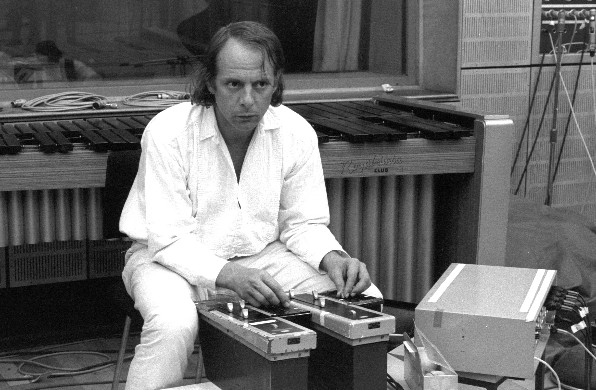
Karlheinz Stockhausen operating two Maihak W49 filters for Kontakte.
Warsaw, 1957
Mine came from the Polish Radio Experimental Studio, which opened in 1957 behind the Iron Curtain, the fourth experimental music studio in the world after Paris, Cologne and Milan.
Eugeniusz Rudnik, a legendary Polish engineer and composer, worked there. So did Krzysztof Penderecki, whose love for clusters reached beyond what an orchestra could provide. The W49 was within arm's reach of both.
I found it almost by accident. A friend of a friend put a photo of it on Instagram, and I sat with that photo for about two years before I wrote to him: hi, maybe you want to get rid of it? He wrote back to say it had come from the Experimental Studio. And then, yes.
It's a small world. The people who care about gear from this era are few enough that some of the threads run back to people who knew Rudnik. In all the years I've been looking, exactly one other has come up for sale.

Eugeniusz Rudnik and Krzysztof Penderecki at the Polish Radio Experimental Studio. Photo by Andrzej Zborski / Fotonova.
Why it doesn't sweep
Both filters live on a single track, 30 Hz to 10 kHz. The high pass climbs from the bottom, the low pass comes down from the top, and they can't pass each other. You see at a glance how much you've taken off each end, which is a lovely piece of design and a slight lie: it looks like a fader and behaves like a switch. Each position is a discrete step.
I resisted the temptation to 'fix' it. Rysy, like the hardware, is a stepped filter. Here's the reasoning, since people ask: a filter you can sweep invites you to sweep it. Your hand goes to the control, the sound moves underneath it, the synth experience we all know and enjoy. Steps take that away. You pick a frequency, you let go, and the only thing left to do is listen. The filter stops being movement and becomes a transformation: I set it like so, this is what the source sounds like now. A different mindset, and one I rather enjoy.

A bandpass filter set on the W49, centered at 800 Hz. The layout makes it easy to see which frequency you're focusing on, which is in line with the era when sounds were measured with a stopwatch before getting committed to tape.
Intensity
One more control, and it's a cool one. The plate reads Schwach at one end and Stark at the other, weak to strong, numbered 1 to 8. This one doesn't go to eleven, sorry.
It isn't a dry/wet. It's steepness: how hard the slopes fall away from your cutoffs. A gentle grade at one end, real teeth at the other.
On the original it's stepped like everything else. In the plugin it sweeps, interpolated across the sampled positions, the one place I went further than the hardware.
It was worth it. Set your two cutoffs, leave them alone, then move Intensity under a held sound: the whole thing opens and closes around fixed points instead of travelling across the spectrum. A completely different gesture from sweeping a cutoff, and I haven't found it anywhere else.
The name
Rysy is the highest peak in the Polish Tatras, and I liked that in two directions. The W49 is the high point the decade arrived at. And the filter has a peak of its own, a lift around the cutoff that sharpens into steep sides as you bring both ends in toward each other.
Rysy also means scratches. That fits too. There's a patina to this thing, and it's easy to push a sound out of shape with it. Not harmonically, the way distortion does, but spectrally. Take enough away and what's left isn't what you started with.
Rysy was the first effect I built, about six months of work, and it set the direction for everything Felt has made since. Version 2 lands in 2027 with the saturation of the chain, free for everyone who owns a licence, as always.
Built in Hamburg. Worked in Warsaw. Now it's mine, and I still don't know everything it does. The controls are simple. What surprises me is where the filter takes you, and what's hiding in the recording you feed it.
The trial runs on your own tracks, free, with no time limit. Go find out what it does to yours.
Plugins mentioned in this article:

Sampled from a rare 1950s filter from the Polish Radio Experimental Studio
$69


